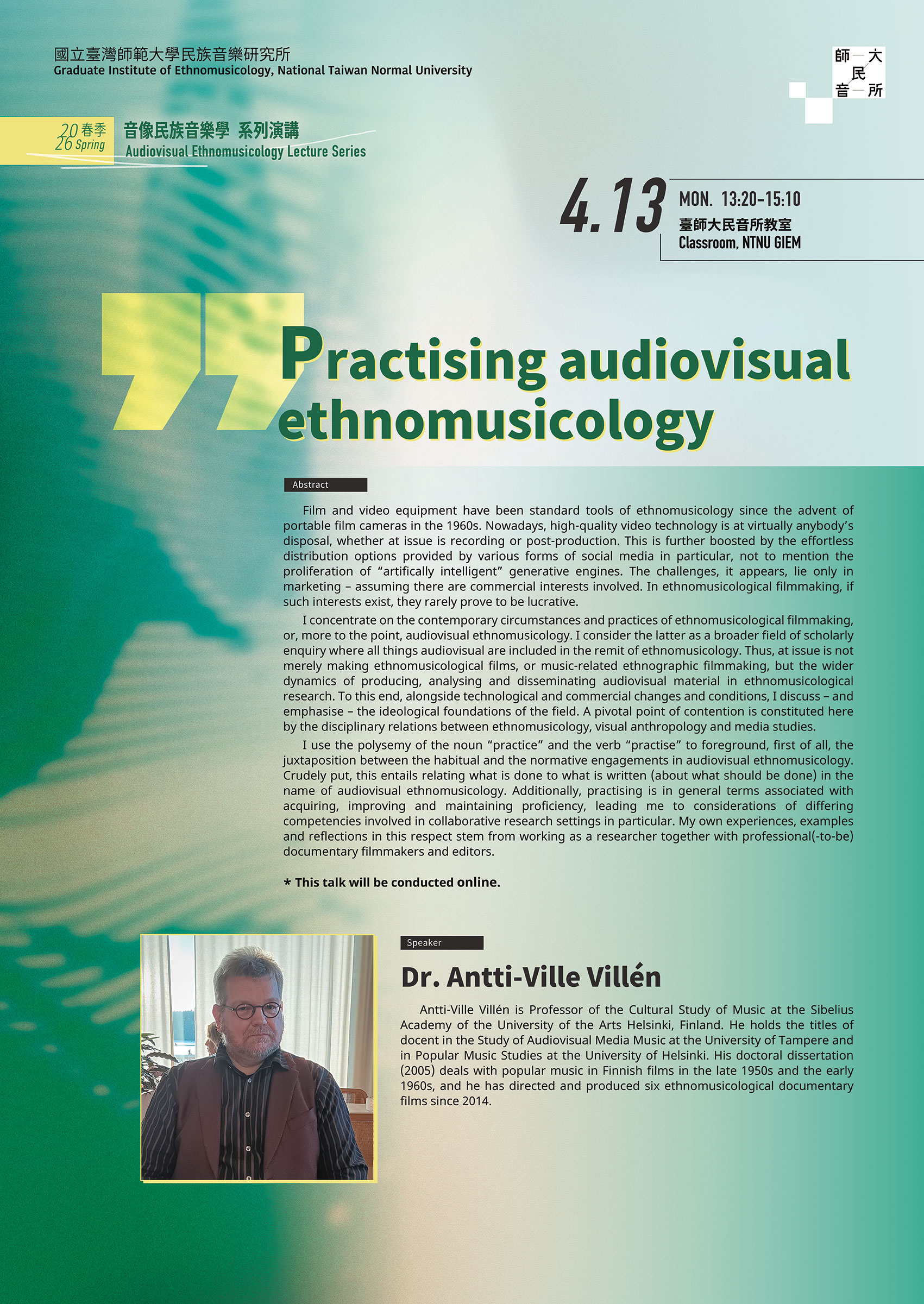
Time: 2026/4/13 (Mon.) 13:20-15:10
Title: Practising audiovisual ethnomusicology
Abstract
Film and video equipment have been standard tools of ethnomusicology since the advent of portable film cameras in the 1960s. Nowadays, high-quality video technology is at virtually anybody’s disposal, whether at issue is recording or post-production. This is further boosted by the effortless distribution options provided by various forms of social media in particular, not to mention the proliferation of “artifically intelligent” generative engines. The challenges, it appears, lie only in marketing – assuming there are commercial interests involved. In ethnomusicological filmmaking, if such interests exist, they rarely prove to be lucrative.
I concentrate on the contemporary circumstances and practices of ethnomusicological filmmaking, or, more to the point, audiovisual ethnomusicology. I consider the latter as a broader field of scholarly enquiry where all things audiovisual are included in the remit of ethnomusicology. Thus, at issue is not merely making ethnomusicological films, or music-related ethnographic filmmaking, but the wider dynamics of producing, analysing and disseminating audiovisual material in ethnomusicological research. To this end, alongside technological and commercial changes and conditions, I discuss – and emphasise – the ideological foundations of the field. A pivotal point of contention is constituted here by the disciplinary relations between ethnomusicology, visual anthropology and media studies.
I use the polysemy of the noun “practice” and the verb “practise” to foreground, first of all, the juxtaposition between the habitual and the normative engagements in audiovisual ethnomusicology. Crudely put, this entails relating what is done to what is written (about what should be done) in the name of audiovisual ethnomusicology. Additionally, practising is in general terms associated with acquiring, improving and maintaining proficiency, leading me to considerations of differing competencies involved in collaborative research settings in particular. My own experiences, examples and reflections in this respect stem from working as a researcher together with professional(-to-be) documentary filmmakers and editors.
Speaker: Dr. Antti-Ville Villén
Biography:
Antti-Ville Villén is Professor of the Cultural Study of Music at the Sibelius Academy of the University of the Arts Helsinki, Finland. He holds the titles of docent in the Study of Audiovisual Media Music at the University of Tampere and in Popular Music Studies at the University of Helsinki. His doctoral dissertation (2005) deals with popular music in Finnish films in the late 1950s and the early 1960s, and he has directed and produced six ethnomusicological documentary films since 2014.